In the early Nineties, a man called Alan Conway went about London telling people he was Stanley Kubrick. Strangely, even though he was English, beardless and had apparently only seen a couple of Kubrick's films, Conway persuaded various influential figures that he was indeed the semi-mythical, hirsute American director who had exiled himself in Hertfordshire. One evening in Covent Garden, a tableful of showbiz-savvy Americans - including the New York Times's then razor-sharp theatre critic Frank Rich, and a Hollywood producer who had actually met Kubrick - fell for Conway's act. As 'Kubrick', Conway gained entrance to the Groucho Club and other exclusive nightspots, where he was careful never to pay a bill or sign a cheque. He went backstage at the theatre and told Julie Walters and Patricia Hayes he was considering using them in a film. Others who thought they had befriended the world's most reclusive 'auteur' included the former Tory MP Sir Fergus Montgomery and the light-entertainment vocalist Joe Longthorne.
Eventually, Conway, a former travel agent, was unmasked in a Vanity Fair article and went on to admit his deception on TV, in a series called The Lying Game. Far from appearing sad or pathetic, there was something morally satisfying about the story. The director of 2001: A Space Odyssey had long ago left behind the world of fame, but celebrity abhors a vacuum. If Kubrick did not want to exist in public, then somebody had to invent him. The reason Conway's invention proved so successful had little to do with his powers of mimicry but much to do with his victims' weakness of vanity. People believed Conway was Kubrick because they wanted to believe one of the planet's most secretive men had decided to reveal himself to them.
'I really did believe I was Stanley Kubrick,' Conway admitted. 'I could have carried on until the day I died.' Or, he might have added, until Kubrick died.
One evening last week, at the door of a grim little flat in Harrow, north London, I asked to see Alan Conway. 'I'm his son,' answered a young man. 'What's it about?'
'Stanley Kubrick.'
'He's dead,' said the man, who introduced himself as Martin Conway.
'Yes,' I said. 'He died a few days ago.'
'No,' he explained. 'My father, Alan Conway, is dead. But come in, I'll tell you about him. You'll get more truth out of me than you ever would have done from him.'
Conway Snr died at home on 5 December last year, just a few months before the man whose identity he had so profitably adopted expired in his country mansion. His son, a 23-year-old law student, invited me into a cramped living-room and set about telling a tale that, in its own twisted way, rivalled Kubrick's for mystery. By turns comic, tragic and bizarre, it also exposed a humanity more raw and complex than any depicted in the filmmaker's oeuvre.
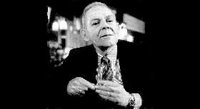 Alan Conway
Conway was born Eddie Alan Jablowsky in 1934. He told friends, in later years, that he was a Polish Jew who had escaped Nazi occupation. In fact, he was born in Whitechapel. At 13, he was sent to Borstal for theft. In a move that demonstrated his cheeky self-dramatisation, Jablowsky changed his name to Alan Conn (Conway was one of his many later personae). By the time he met Martin's mother, he had a string of convictions for deception. The family moved to South Africa, but had to return when a number of Conway's business deals came under official scrutiny. Nevertheless, back in Britain he was able, with his wife, to build a travel agency with offices in Harrow, Muswell Hill and London's West End.
Things started to go wrong in the late Eighties, when Conway left his wife for his gay lover, who was to die later of Aids. The business collapsed, he became an alcoholic and started to indulge his fantasies. Kubrick once said that 'watching a film is really like taking part in a controlled dream'. For Martin Conway, watching his father's life was like an uncontrollable nightmare.
After his mother died, Martin moved in with his father, who was prone to violent fits of temper. 'He physically abused me and set his friends on me. Once, one of them chased me in front of a car and I broke my kneecap. He terrorised me.' Eventually, the social services became involved and, aged 16, Martin was placed in a children's home.
'He used to answer the phone in this terrible American accent,' recalls Martin. 'And his friends used to call him "Stanley".'
While he was in summer season in Torquay, Joe Longthorne met Conway, or rather a man he took to be Kubrick. Longthorne does not want to talk about the episode but his agent told me the singer thought the director was 'going to make him a star. Joe treated him like a king. He laid on a Roller for him and put him up in a top hotel. The guy told Joe he was going to put him in his next film'.
Quite what the seaside entertainer thought the most obsessive filmmaker in history was doing talent-scouting on Devon's cabaret circuit is not clear. Longthorne's extravagant hospitality came to an end a week later when he learnt, via Warner Brothers, that Stanley Kubrick was not in fact in the vicinity of the English Riviera.
Longthorne's was the most expensive example of gullibility but, arguably, not the least likely. That award probably goes to Frank Rich, the former 'Butcher of Broadway'. He and his friends invited a drunk Conway to join them at their table in Joe Allen's restaurant. Conway was with Sir Fergus and a couple of young men who caused the Americans to suspect the three-times married Kubrick was homosexual. 'Everyone always thought Hal the computer acted like a jealous gay lover,' Rich observed.
Again, having made their appeals for exclusive interviews, the journalists were disappointed to learn, on checking with Warners, that their man was an impostor. One of the party was so beguiled by the 'counterfeit Kubrick' that, unthwarted by Warner's denials, he contacted Kubrick's lawyer, only once more to be told that the director was still with beard and was not in the habit of dining in London restaurants. The lawyer informed Kubrick of his alter ego. Apparently, the director was fascinated by the idea.
Back at home, Conway was increasingly unable to distinguish between his real life and the fictions he was creating. If ever his son confronted him with his fantasies, the father would accuse him of lying. Conway would later say that, almost in a dream state as 'Kubrick', he travelled to New York and Rio (Kubrick, of course, hated to fly and, as far as anyone knew, had not left England for years). Martin doesn't know if these trips took place or were imagined.
In 1995, Conway checked into the Priory, to be treated for alcoholism. He never drank again and became a committed member of Alcoholics Anonymous. One of the tenets of AA is that participants are punishingly honest with themselves and with each other. As part of this process, they are called upon to recount their biographies. Martin came across his father's AA diary and learnt that he had invented yet another life story in which he had businesses in the Cayman Islands and led a flamboyant lifestyle far away from the drudgery of Harrow. 'He was a compulsive liar,' said his son, shaking his head in disbelief.
In his will, Conway left £30,000 to a former friend, £5,000 to another man, and the rest of his money to his son. The only problem was that Conway didn't have a penny. Martin discovered that the former friend, whom he assumes had mistaken Conway for Kubrick, was still owed £30,000 by his father and the will was just a jokey reference to the debt. Martin also showed me unpaid bills in different names from Amex, Barclaycard and other companies, running into many thousands of pounds. There was an outstanding phone bill for £879.17, primarily from calling gay chat lines.
Conway died from cardiac thrombosis, although initially the police suspected foul play owing to an unexplained bruise on his neck. Whatever happened, it sounds like a lonely death, far more solitary than the demise of the supposedly hermetic Kubrick. Martin, who had been living with Conway again, was not there when his father died. He still harbours an enormous and understandable resentment towards a man who, in his fantasies and personality swings, eluded everybody including himself. Yet, as he says, he misses him.
A short while after Conway died, his son returned to the flat and heard an answerphone message. 'Hi Stanley,' said a threatening voice. 'I'm going to get you this time. I'm going to get you.' The truth is, though, nobody ever really got 'Stanley'.